Showing posts with label zingerman's. Show all posts

Thursday, May 28, 2009

Cocktail Challenge: The Sazerac


As foreshadowed in my last cocktail challenge post, I did head into the Absente drinks, starting with the Sazerac - Jim Beam Straight Rye, Absenté, and Peychaud's Bitters with simple syrup, lemon oil, and a twist. I thought this might be okay, because I'm a big fan of Jim Beam Straight Rye. But this cocktail was a little aggressive for me... Strong - not a lot of mixers in there. It was reasonably good for careful sipping when it cold, but as it warmed up the anise taste from the Absente started to become much more prominent. So I just kept slipping ice cubes in, and found that it started to grow on me a little bit, especially once the ice diluted it a little more.

Still, this isn't one that I'd order again. But I didn't expect to like them all, so that's okay!

Tuesday, May 19, 2009

Cocktail Catch-Up

Well, I had this theory about writing a nice blog post about each cocktail I've tried so far in my cocktail challenge. But I've fallen behind, and starting to lose track of what I drank. So I'm going to write one big catchup post with notes, and then hopefully will be back on track to do the one-by-one...

Manhattan - Trying drinks like this is one of the reasons I set myself this cocktail challenge. Because it's a true classic, and something that any budding cocktailian (is that a word?) should be familiar with. Zingermans' version includes Jim Beam Straight Rye (which I love), Vya Sweet Vermouth, Gary Regan's Orange Bitters No. 6, and a real maraschino cherry. With no non-alcoholic mixers, I was worried that this was going to be really strong, but it was really quite delightful, and not too sweet. The housemade maraschino was a treat when I got to the bottom of the glass.

The Knickerbocker - Brugel Dominican Dark Rum, Bol's Orange Curacao, muddled fresh raspberries and freshly squeezed lemon juice. This is a girly drink if I ever saw one. It's sweet and pink, and kind of like candy. Definitely easy to drink, but fairly unremarkable.

The Bronx - Plymouth Original dry gin, Vya dry vermouth, Vya sweet vermouth, freshly squeezed orange juice, Gary Regan's Orange Bitters No. 6. I like gin, and adore Vya dry vermouth, so this was an easy pick for me. It's been a while since i tried this one, but I'm sure I liked it...

Champagne Cocktail - A touch of sugar, a dash or two of Angostura Bitters, L Mawby Blanc de Blanc. And a lemon twist, though that's not listed in the ingredients. I love sparkling wine, and wasn't sure how I'd feel about having it "adulterated" but this was just a lovely, festive cocktail, with the bitters giving it a really nice complexity.

Ward Eight - Jim Beam straight rye, freshly squeezed lemon juice, freshly squeezed orange juice, superfine sugar, pomegranate grenadine. Knowing I liked the Jim Beam rye, when I started the cocktail challenge I tended to pick the rye drinks. This bears a lot of resemblance to my favorite cocktail, the Scofflaw.

Jack Rose - Laird's applejack, freshly squeezed lemon juice, pomegranate grenadine. Another girly drink, but the lemon juice keeps it from being cloying.

Buster Brown - I tried this one on the strength of Mom's Kitchen's comment on my last post. And I was not disappointed. Maker's Mark bourbon, freshly-squeezed lemon juice, simple syrup, Gary Regan's orange bitters No.6. Smooth and very easy to drink, but not too sweet.

Blood and Sand - The Famous Grouse scotch whisky, Vya sweet vermouth, cherry Heering, freshly squeezed orange juice. Not as sweet as I feared (but still pretty sweet) this had a nice complexity.

The Monkey Gland - Plymouth Original dry gin, freshly squeezed orange juice, Bénédictine, pomegranate grenadine. The Benedictine was definitely an interesting flavor component, and I'm looking forward to trying it in some of the other drinks.

So that's 10 out of 35 - making pretty good progress. However, not being a huge anise fan, I've been avoiding the drinks with Absente in them, and there are a LOT of them. I think I'm going to start working on them next, for two reasons - a) I suspect I'll like them more than I think I will, and b) if I don't like them, I don't want to have a whole lot of them piled up at the end!

Tuesday, April 14, 2009

Woman on a Mission

Tap, tap, tap... is this thing still on? Seems to be.

I've been sadly neglecting this blog, but since I was still getting a few dozen hits a day and people seemed to find some of my old content useful, I decided that I should leave it up. Just in case anyone needed ideas for things to do with duck fat, or how to cook jambalaya for a crowd.

But I'm on my summer hiatus from scheduled chocolate making for the business side of Tammy's Tastings (special orders still accepted), so I've got a little more time to devote to blogging.

And something to blog about.

I'm a big fan of the classic cocktail list at Zingerman's Roadhouse. With all freshly squeezed juices and good bitters and other specialty ingredients, Zingerman's has the best cocktails in town, I think. It's a serious list, not just a bunch of overly sweet "something-tinis."

But I quickly got into a rut once I discovered the Scofflaw (Jim Beam rye, Vya dry vermouth, lemon, pomegranate grenadine, orange bitters). It's my favorite cocktail ever, and whenever I'd go to the Roadhouse I'd look fondly at the rest of the list, then order my usual.

A few weeks ago, I decided it was time to break out of my rut, so I set myself a mission - try every cocktail on the list. There are 35, and since I set the goal I've tried 7, a different one on each visit. I was already starting to lose track of which ones I'd had, and what I thought about them, so I thought this was a mission worthy of dusting off this old blog.

I'll fill in the first 6 in separate posts, but for now I'll talk about last night's cocktail - The Jupiter.

This is quite a dry cocktail, especially in contrast to the Jack Rose that I'd had on my last cocktail outing. Zingerman's version has Plymouth Gin, Vya Dry Vermouth, Parfait Amour, and freshly squeezed orange juice. But the orange juice is more of a garnish than anything else - the drink is almost clear, with only a bit of floating pulp to make you believe there's juice in there (future posts will have pictures). I wasn't familiar with Parfait Amour, so James brought me some on its own to taste. It's a very sweet liqueur, with a slightly bubble-gum like aroma and flavor. It's hard to put your finger on exactly what it tastes like, but there were definitely vanilla and floral bits in the taste I had. It adds a really subtle note to the cocktail, but I'm sure I'd have missed it if it wasn't there.

I'm used to slightly sweeter and tarter cocktails, so my first sip of this was a bit of a surprise. But I figure it's training wheels for when I work up to having a martini. It was definitely a sipping drink, and as I sipped it really grew on me, and it was a nice drink to relax over while listening to jazz and talking to my neighbors seated at the bar.

7 down, 28 to go...

Sunday, December 10, 2006

The Future of Zingerman's

Zingerman's lays out its vision for 2020. It includes:

  • Zingerman's will stay in and around Ann Arbor.
  • Zingerman's will grow to include 12 to 18 different businesses. A Mexican restaurant, bed and breakfast, candy company, Asian noodle restaurant, conference center and publishing company are among some of the ideas being tossed around.
  • Zingerman's will remain an open-book business for its employees, meaning all workers have access to - and are expected to know and understand - the company's financial records.
  • Zingerman's will establish its own nonprofit foundation.
  • Zingerman's will expand its educational opportunities to have international exchange programs for employees, an internship program and a scholarship program for people in the community who want a food career.
The article is a good quick overview of how the company developed from a deli to something resembling a foodie empire.

Saturday, September 09, 2006

Spanish Olive Oil and Vinegar Tasting, part 2

In my last post, I'd just finished describing the six olive oils we tasted. Now we moved on to the vinegars. Sherry vinegar, to be precise.


(Ignore the scribbles on the labels - these were the sample bottles from the shelves, which - for obvious reasons - are marked.)

We tasted 3 vinegars from Lobato (in the pictures above they all have the word capirete on their labels). One was 8 years old, one was 20 years old, and the last was 50 yrs old! Of course, as we discussed at some length, "years old" is a difficult thing to understand when it comes to sherry vinegars, or sherry for that matter, as they both use the solera system that blends wines or vinegars from different vintages.

Sherry vinegar is kind of interesting. There is a saying in Jerez, from which Sherry hails, that "each cask chooses its on destiny." Some casks of sherry wine age as normal, while others begin to turn to vinegar, and it's not always clear why this happens. Up until 1933, Sherry vinegar wasn't a commercial product. The wine makers always had it, and local cooks would get some from them as well, but no one was producing it for sale until 1933. Sherry vinegar, like Sherry, is made from the Palomino grape, and is aged in American oak barrels.

Unlike when we tasted the olive oils, where you want to breathe deeply and slurp air to maximize the flavors, we were advised to be much more cautious with the vinegars. So we smelled them from a distance while swirling the cups to waft the aromas up to our noses. And we took teeny-tiny sips, or even watered the vinegar down just a bit to be able to appreciate the flavors without the overwhelming acidity.

The 8 year old was the most "vinegary" of the bunch, with a quite high level of acidity. It had a really potent and aggressive nose too, with butterscotch and caramel and a hint of iodine. The 20 yr old vinegar was much more mellow - the nose wasn't harsh at all and had sweet caramely notes. It was smooth and rich and sweet on the tongue too (although you must understand that this is still vinegar we're talking about here, so sweet is relative!). The 50 year old had a really faint nose, and quite a different flavor than we expected. Sherry vinegars are quite different from balsalmic vinegars, which get more and more concentrated and sweeter as they get older. The progression isn't nearly so clear with Sherry vinegars, so this 50 year old vinegar was more acidic and less sweet than the 20 year old. But still not nearly as acidic as the 8 year old, of course! And its flavor was quite fruity.

Having tasted through this "vertical" of Lobate vinegars, we moved onto another producer - Romate - next. Romate is one of the last bodegas in Jerez that still fully locally owned. From them, we tasted a 25 year old standard sherry vinegar, and then a PX vinegar, made from Pedro Ximenex grapes rather than Palomino. The 25 year old was the consensus favorite of all of the standard sherry vinegars. It still smelled quite a bit like sherry, and was really quite sippable! Unlike the Lobate vinegars, which were dominated by dark notes like caramel and butterscotch, this vinegar had lots of high notes to balance the caramel that mostly showed up on a long finish.

The PX vinegar was quite a different beast. Its color was very deep chestnut in comparison to the tan of the others. It's production method is different as well - they take a base of really old vinegar and add to it a small amount of aged sherry, causing a second fermentation cycle as the new sherry turns to vinegar. After that is done, the vinegar is bottled. This complex approach shows through in a complex flavor profile, and the vinegar was another that was pretty "easy" to approach.

I already own a bottle of the 8 year old Sherry vinegar, so I didn't purchase any that night. But I might splurge and get the Romate 25 year old some time - one of the nice things about Sherry vinegar is that even the older bottles aren't very expensive. (With the exception of the PX, which retails for $60 at Zingerman's!)

At this point in the tasting we got to try out the oils and vinegars in some different contexts. First we each got to mix our own vinaigrette to eat with some salad greens (my combination was the Coupage olive oil and the 20 year old Lobate vinegar). Then we tried a small sample of Zingerman's cream of tomato soup alone, and then again with the last minute addition of a spoonful of 25 year old Sherry vinegar. Definitely a flavor enhancer! And we tasted some tomato sliced drizzled with the PX vinegar and sprinkled with sea salt. Again, the major effect was just to enhance the flavors of everything.

The last thing we did was to go back to the olive oils via a blind tasting, to see if we could identify one of the oils we'd tasted in the first go round. One of the attendees was too full to eat another bite, so she poured the mystery oil while the rest of us - including Gauri - waited in the hallway. The mystery oil was the La Amarilla de Ronda and - embarassingly - not a single one of us got it right! Gauri gave the prize (a small can of the LA) to the person who guessed the Coupage, because at least she'd guessed that it was a blend rather than a single varietal.

A very fun evening. These Zingerman's tastings are always a good time and educational too. And at $20 per person, they can be a good bargain, especially if - like me - you take advantage of your 20% off certificate (good that night only) to stock up on oils and vinegars for home!

Thursday, September 07, 2006

Spanish Olive Oil and Vinegar Tasting

It's Spain month at Zingerman's, and last night I attended a tasting of Spanish olive oils and vinegars. Unlike most of their tastings, this one was pretty lightly attended - just 7 of us plus Gauri, our friendly and helpful guide for a tour through Spain.

We started off by tasting 6 olive oils, alone and with bread. As with wine tasting, we started off by looking at the oil, then smelling it, and - finally - slurping it loudly to taste it. The flavor of the oil changes depending where on your tongue it's landing, so it's interesting to note how it evolves on its way down your palate. And you must watch out for the hit of pepper that can grab your throat on the way down. (In Italy, Gauri told us, they judge oils based on whether they are a "one-cough" or "two-cough" oil.)

The first two we tasted were both from near Barcelona, and both made exclusively from Arbequina olives. They were both a bright sunny yellow, with only a hint of green. The first, L'estornell, was a very light oil, with a fruity, grassy nose. It was the mildest of the oils we tasted, inspiring words like "silky, smooth, and delicate." It had just the slightest hint of pepper. The second, Olei Floris, had a very different nose with very strong aromas of tropical fruits and flowers. While the nose was interesting, the taste seemed really off to me - almost as if it was on the edge of rancidity. I raised it to Gauri's attention, and sure enough, a fresh bottle showed none of the characteristic I'd found objectionable. Whereas the L'estornell was very light, this oil was very viscous and thick, and the flavor was correspondingly round and full.

Next, we moved South in Spain, to the Tabernas dessert. Where the oils of the North are mostly made from Arbequina olives, those from the south rely exclusively or in part on the Picual olive. The flavor from the Picual is much more assertive, and apparently Southerners refer to the oils of the north as "cat piss."

Well, we all said upon sampling this next oil, we'd be thrilled if our cats pissed this! The Castillo de Tabernas 100% Picual oil was light green, with moderate viscosity. It was green on the nose too, with lots of different herbal aromas and a hint of mint. The flavor is green and quite assertive, with lots of pepper in the throat. Very different from the preceding Arbequina based oils - rustic rather than refined.

And very different from the next oil, a blend from the very same producer. The Castillo de Tabernas - Coupage is a blend of 60% picual, 20% arbequina, and 20% hoji blanca. A bright yellow-green oil, both the color and viscosity were lighter than the preceding oil. The nose was very floral. In taste, this was a very fresh and smooth tasting oil, with a hint of lemon or other citrus, and a lot of complexity. Tasting these two side by side illustrated the power of the blend - the 100% Picual oil was noticeably less complex, with a lot of up front flavor and a lot of pepper on the finish, but nothing in the middle.


Next up was La Amarilla de Ronda. (You can see its stylish "LA" can next to the L'estornell and Olei Floris above.) Another blend of Arbequina, Picual and Hoji Blanca, this oil is made by a producer who is best known for making wine. He's taken a very winemaker-ish approach to olive oil, and purchases oil from two different villages, carefully blending them in an attempt to reflect the flavor of the region. (Gauri said that this all felt really pretentious to her, so she really wanted to dislike this oil. But then she tasted it.) Another yellow-green oil, with a nose of flower and fruit, it had quite the interesting evolution in my mouth. It opens very mild, then has a hint of fruity sweetness, before a really assertive peppery bite on the finish. Having taken a perhaps too-large slurp, I rated this one a three-cough! Very interesting.

The sixth and final oil was quite different from all the rest. Mariano's oil is from a town very close to the border of Portugal, at about the midway point north to south. It's made of 100% Manzanilla olives (not the kind usually marketed under that name, but a cousin). It was quite a pale yellow, with a very flowery and sweet nose. The nose was completely deceiving, however, as the flavor was extremely different from what the nose implied! It was very herbal and reminded me distinctly of oregano. It was quite complex and interesting, with a bitter finish that made it distinct from all of the other oils we tasted. It was also the oil that tasted most different with bread than on it's own, once again tricking your expectations. (In the topmost picture of this post, the Mariano's is the short square bottle in the front middle.)

And that was our pass through the olive oils. Next up: five very different Sherry vinegars.

Wednesday, September 06, 2006

Pata Negra

The black pig. Jamón Ibérico.

If you've read Peter Kaminsky's book Pig Perfect (and if you haven't, you should) then you'll know that Jamón Ibérico is the pinnacle that all other ham aspires to. It's produced only in particular regions in Spain, from one particular type of pig, and that pig must be raised in a particular fashion. In the period just prior to their slaughter, they feed only on acorns, which gives their fat a unique flavor and texture - and, strangely enough, makes the fat unsaturated! That's right - the king of ham is good for you.

Until very recently, Jamón Ibérico was not available in the US. But finally some Spanish producers have received permission from the US government to export their goods. Here's a website that's offering a wide range of Ibérico products. Beginning this month, Zingerman's Deli has joined the small group of vendors offering Iberico for sale. At this point, they "only" have three kinds of cured products available - chorizo, sauccison, and lomo (cured pork loin). They hope to have the actual ham in a few months.

According to this Wikipedia page, "Jamón ibérico only accounts for about 5% of Spain's cured-ham production, so it is very expensive." Very expensive is kind of an understatement. The two sausages Zingerman's is selling retail for $50 per pound. The lomo is even more expensive - a princely $100 per pound!

It is to Zingerman's credit that they are not letting those prices hold them back from pressing samples of pata negra on practically every customer who walks in the door! So I've managed to taste a number of slices of the lomo. Is it worth $100 per pound? Hard to say. It's intensely marbled - beyond marbled, in fact, the meat is downright speckled with fat. The flavor is subtle and smooth and sublime. It almost melts in your mouth. And fortunately, a little goes a long way - $10 worth of lomo would give you a lot of satisfaction without breaking the bank. The six paper thin slices shown above cost me $3 - a worthwhile expense for a treat to thank my husband for staying home with our two year old while I went out to Zingerman's to taste olive oils and vinegars (but more on that in another post).

Saturday, August 26, 2006

Chef Profile

Kitchen Chick has posted a great profile of Chef Alex, the man behind the Zingerman's Roadhouse tomato dinner. Learn more about the man behind the tomatoes, and why the Roadhouse is so expensive.

Lisa's own photo essay of the meal will be going up soon. She's an excellent photographer, so I'm looking forward to checking it out.

Friday, August 25, 2006

Heirloom Tomato Dinner


Zingerman's Roadhouse
holds a special dinner about once a month. There's always a theme, which might be connected to a special guest (like Bill Niman or Andy Quady) or a particular style of food (California BBQ) or - as in the most recent dinner - a specific ingredient. The ingredients in this case were more than 30 different kinds of heirloom tomatoes, plus heirloom varieties of potatoes and carrots as well. To take things even a step further, all the vegetables served at the dinner were grown in Chef Alex's own garden. Given that there were over 100 people at the dinner, one imagines that it's a heck of a garden!

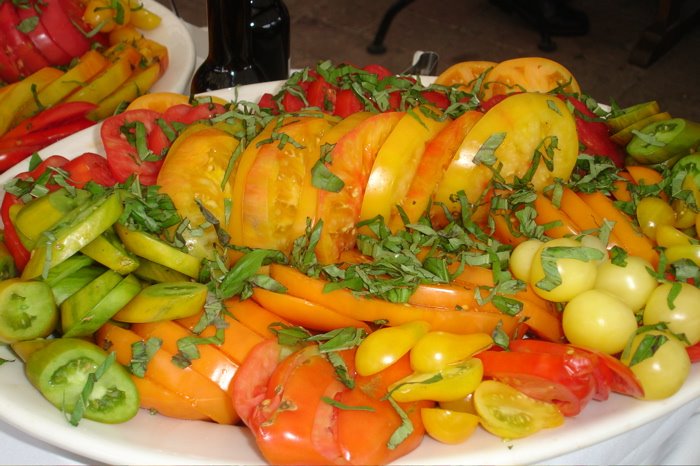
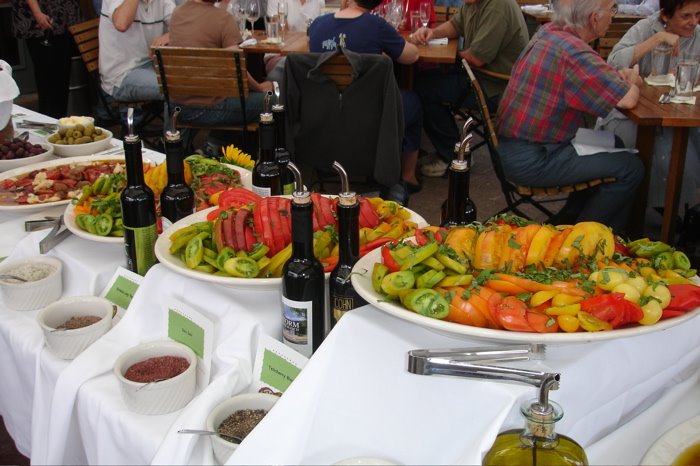
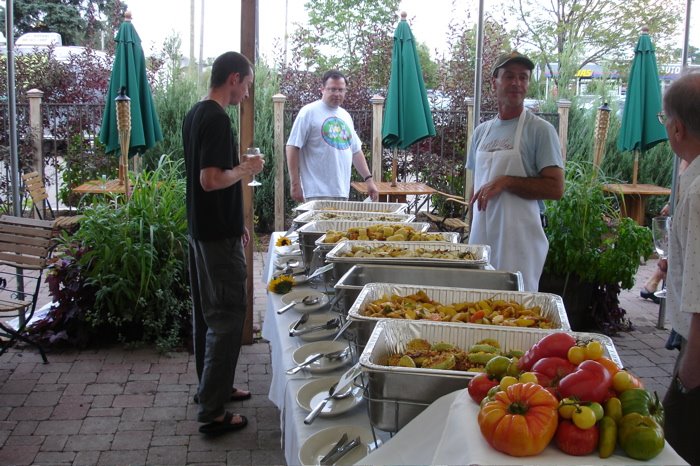
I've already written about the cocktails, so I'll go straight to the food. Dinner was served buffet style. (Side note: I greatly prefer the special dinners that are served as a number of plated courses - they allow for better pacing, more focus, and some really well thought out wine pairings. But I decided to attend anyway, because I had a friend visiting.) The buffet line started out with two different kinds of gazpacho, a green and a red. The green had some heat and sharpness to it, and I prefered the mellower red. Then we entered into the realm of the "bruschetta bar." Bread, piles of sliced tomatoes in a rainbow of color, several different olive oils, and even multiple salts and peppers to choose from. Then several different cheese presentations - simple slices of made-that-day fresh mozarella from Zingerman's Creamery, and a couple of different marinated goat cheeses. These were all excellent.


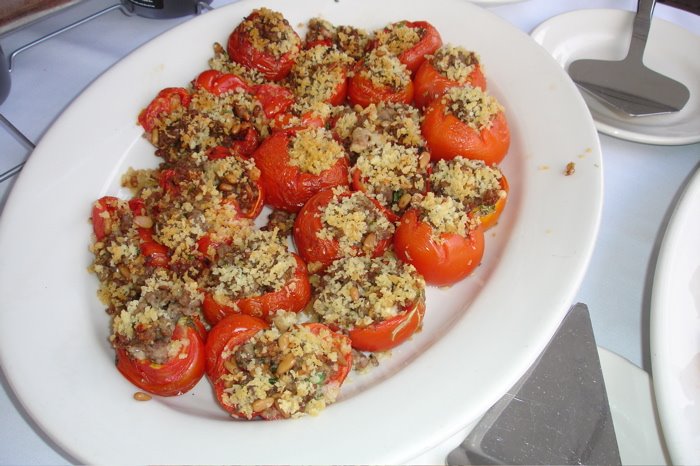
The hot items included two different recipes for fried green tomatoes (one with bacon, one without), the aforementioned heirloom potates and carrots, roasted patty pan squash, "Three Sisters Succotash" (green beans, corn, and early winter squash), grilled California sardines with tomato sauce, risotto with leeks and celery, two different stuffed tomatoes - one with tuna and one with Italian sausage, and an incendiary green tomato pie with roasted cayenne peppers.


A lot of food. All of it excellent, except maybe the green tomato pie, which was hot enough to burn out the tastebuds you wanted to use on the rest. The risotto was probably my favorite, if I had to pick one. Oh, and my take on the bruschetta bar, where I topped a variety of tomatoes with Pasolivo olive oil, some variety of pink salt, and Balinese long pepper, then a slice of fresh mozarella. Mmmm. The freshness of all of the vegetables really shone through in all of the items.

The buffet selections were accompained by pours of three different "summery" wines:
Sauvignon Blanc, Matetic Vineyards, 'EQ,' San Antonio DO, CHILE, 2003
Vernaccia di San Gimignano DOCG, Riccardo Falchini, Toscana ITALIA, 2004
Tempranillo, Bokisch Winery and Vineyards, Lodi CA, 2002

The Sauvignon Blanc was really excellent. Very classic, aromatic sauvignon blanc nose (I always love the way these smell) with tropical fruits and green grass and grapefruit, and then nicely rounded on the palate, not as one-dimensional in flavor as even some of the best smelling sauvignon blanc can be. So I was very pleased to have a chance to taste it and will have to look for it. The Tempranillo was also much liked at our table.

But one of the highlights of the dinner was yet to come. Dessert was a delightful cookie with cornmeal, lemon zest, vanilla and (perhaps?) pinenuts, served with an assortment of three different gelatos - tomato, basil and olive oil! The tomato was flavored with a tomato butter, so had a little bit of heat and hints of nutmeg or cloves or some other sweet spice. The basil was really basil-y. And the olive oil tasted like, well, olive oil, and was just excellent - but I'm definitely a fan of odd flavors in my ice cream. Very clever and memorable dessert. Olive oil and other savory ice creams aren't unique (in fact, they're becoming downright trendy), but these were very well executed examples of the genre.

Wednesday, August 23, 2006

Celery Sour


Consider the picture above a sneak preview of a future post about the excellent Heirloom Tomato Dinner I attended at Zingerman's Roadhouse last night. But I don't have time to write that post right now.

So instead, I'm going to talk about celery.

Did you know that Michigan used to be one of the country's major celery growers? Sadly, in recent years we've dropped quite a bit. But once upon a time, Kalamazoo, MI was a major celery center. One of the products that was produced in Kalamazoo was a celery bitter.

Unless you're a cocktail afficianado, the only bitters you've probably heard of - if you've heard of them at all - are Angostura bitters. But once upon a time, there were many different kinds of bitters. Orange bitters, mint bitters and yes... celery bitters. Want to learn more? For the Cliff's notes version, checks out this Wikipedia entry on bitters. If you're really hardcore, delve into the "All About Bitters" thread on eGullet.

Zingerman's Roadhouse has a "classic cocktail" program, and they've dug up all sorts of archaic cocktail recipes. For the Heirloom Tomato dinner they offered three different cocktails - a classic Bloody Mary, a tomato water martini, and a celery sour. Celery bitters are an essential component of a celery sour. But there's a small problem - no one makes celery bitters anymore. Fortunately, little details like that never hold Zingerman's back from seeking quality and authenticity, so they set out to make their own.

Unfortunately, I don't have the recipe for those. I only have the recipe for a celery sour, which may not do you much good without the bitters (but could be worth a try anyway...)

Celery Sour

chiffonade of celery leaves
ice
1 part gin (preferably Plymouth)
1 part freshly sqeezed and strained lemon juice
1 part fresh pineapple juice
4 drops of celery bitters

Place some of the celery leaves in the bottom of your glass. Add a few drops of gin and muddle to release the celery goodness. Add ice and the remaining liquids. Shake in a cocktail shaker and pour back into the original glass.

Of the three cocktails, this was by far the unexpected favorite. (In the picture below, it's the leftmost.) I look foward to getting back to the Roadhouse to try it again!