Showing posts with label dinner. Show all posts

Monday, January 01, 2007

Happy New Year!

I hope everyone had a festive time and drank lots of excellent champagne or other beverage of choice. I celebrated the new year with a dinner party for my friends with children, then - after my 2 year old was asleep - went to a party at a neighbors. (Sadly my hubby had a headache and opted to stay home and sleep.)

It was quite the dinner - 8 adults, 7 children (ages 8, 3, 3, 2, 2, 1 and 8 months), 5 courses, and 3 wines! The menu was inspired by my recent find of some fun plates at the local dollar store. I covet square plates and other cool shapes, but haven't been able to justify spending the money since I don't have dinner parties very often. But at a dollar apiece, I couldn't resist these little rectangular and oval plates. They're too small for an entree, but are the perfect size for small courses!

Scallops with leeks, trout roe caviar and champagne cream sauce
Wine: Jaillance Cremant de Bordeaux Cuvee de L'Abbaye Brut
Non-scallop alternative for Sue
Butternut squash ravioli with rosemary oil
Wine: Bonny Doon Pacific Rim Dry Riesling
Mushroom stuffed quail with risotto, haricots verts, black poplar mushroom garnish
Wine: 2001 Colognole Chianti Rufina
I forgot to photograph the cheese board. We had three Italian cheeses - a Pecorino Tuscano (sheep), Maccagno (cow), Robiola Fia (goat) - and a loaf of no-knead bread, which we used for sopping up sauces in the earlier courses as well.

Caramel-hazelnut-chocolate tart with creme fraiche whipped cream
The kids were pretty good about letting us eat in relative peace. They had hotdogs, macaroni and cheese, and peas as their dinner. The house was an absolute wreck this morning though - toys strewn everywhere! Which is a relatively small price to pay for a grown-up dinner, I guess!

Monday, November 06, 2006

Things to do with duck fat, part two in a series

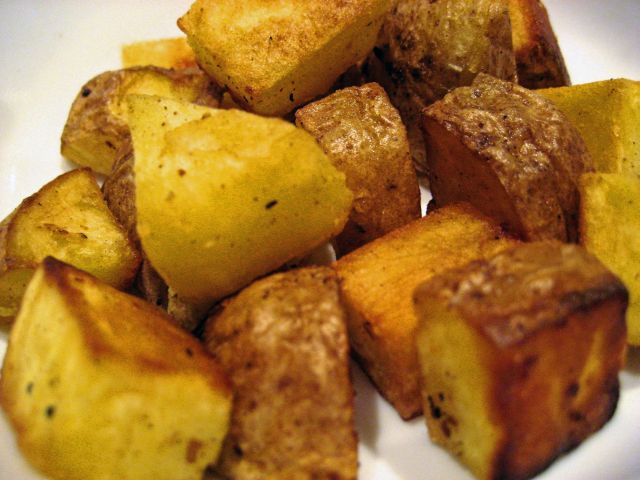
The duck fat roasted pumpkin seeds were a success, but I still had most of a container of duck fat sitting in my fridge. When I needed a quick and easy dinner on Friday, I decided to make breakfast for dinner. Scrambled eggs, sauteed mushrooms, some home-cured maple bacon from my friend in Chicago, and potatoes pan fried in duck fat.

Duck Fat Potatoes
1 lb potatoes
3 tbsp duck fat
salt and pepper to taste

Cut the potatoes into smallish pieces - maybe 3/4 inch? You can peel them if you like - I was using some new red potatoes, so I just left the skins on. Melt the duck fat in a pan, add the potatoes, and season with salt and pepper. Put a loosely fitting lid on the pan and let cook 10 minutes over medium to medium-high heat before stirring - you want the potatoes to get nice and crusty. Stir, and continue to cook loosely covered for about 15-20 minutes, stirring very occasionally, until the potatoes are browned and crispy on the outside and cooked through. Serve hot.
There are a couple things about duck fat that make it superior to oil or other fats for this application. One is flavor - the duck fat has a lot of flavor compared to something like canola oil, and a more savory flavor profile than olive oil. So it imparts a lot of flavor to the potatoes. The day I cooked these, I was suffering from a recurring sodium sensitivity that I have. Salt-less potatoes are usually less interesting than library paste, but these were actually pretty good (although the ones my husband sprinkled salt on were even better).

The second thing is crispiness. I'm not sure the mechanism behind it (smoke point? saturated vs. non-saturated?) but I found that - as compared to oil fried potatoes - these potatoes got crispier and browner without getting greasy.

I still have about half the container in the fridge, so stay tuned for part three.

Sunday, October 29, 2006

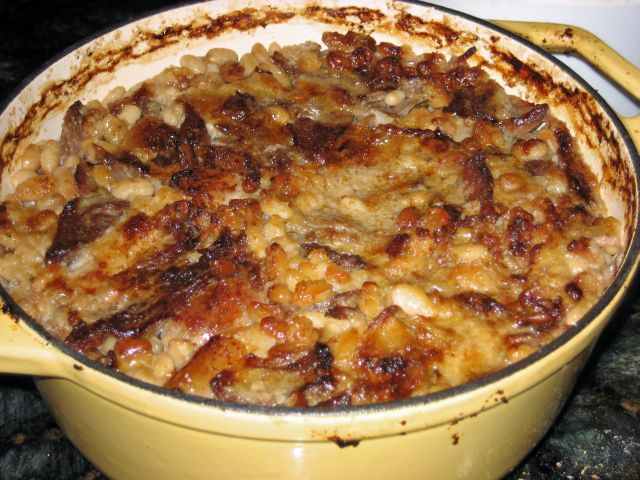
Project Cassoulet est fini!

I'm pleased to report that the cassoulet (see earlier post) turned out pretty well. Especially since I had to make some on-the-fly modifications to the cooking instructions when I was just too busy making chocolates on Saturday to also make and bake cassoulet. (The recipe calls for cooking it one day, refrigerating it overnight, then cooking it again before serving.) But my son woke up WAY early today, so that gave me lots of time to play with today.

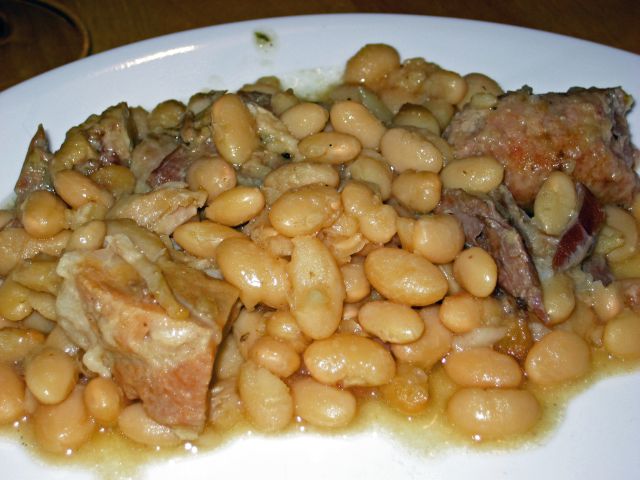
Everyone seemed to really like it. It's certainly a completely decadent kind of meal - the beans absorb the fat from the duck and pork, and get a lovely creamy texture. The long slow braise makes all the meat melt in your mouth tender, although much of the flavor of the meat goes to the broth. Definitely a fun experiment to have tried, although I'm not sure if the results are worth the effort or expense (although making my own duck confit would have saved me a bundle).

We served it with the 2001 Domaine de la Tourade Font des Aieux Gigondas. I had planned to decant it, and should have, as it improved quite a lot in the glass. It was a nicely assertive wine with good structure, tannins and acidity, which allowed it to cut through the out-of-control fat content of the cassoulet.

If you'd like to try it for yourself, the recipe I used is here.

Thursday, October 05, 2006

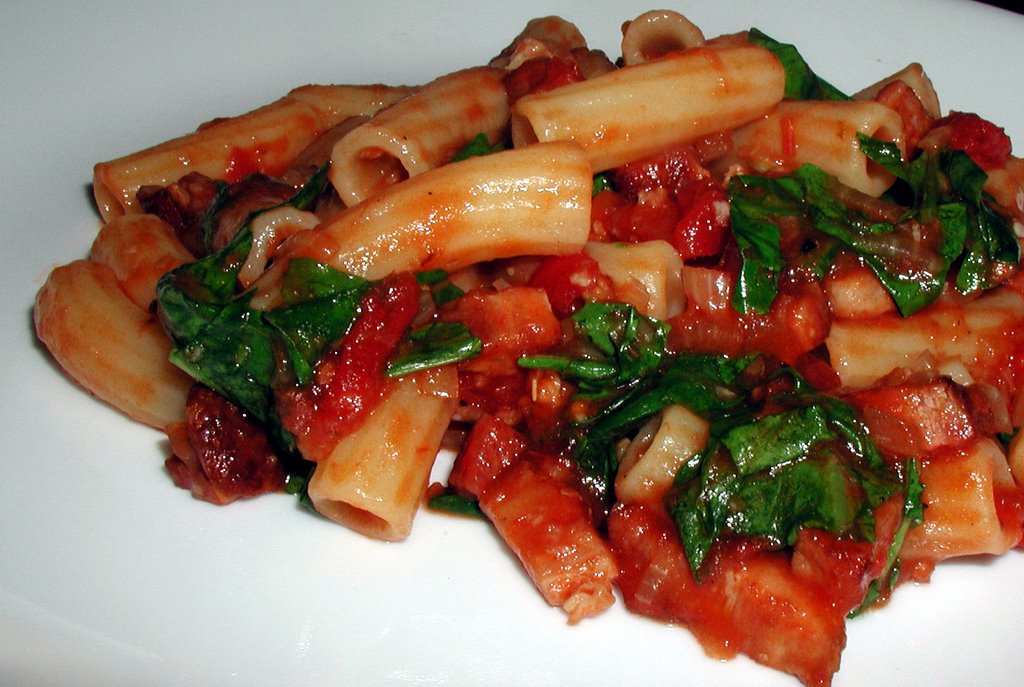
Pasta Amatriciana with Arugula


Pasta Amatriciana with Arugula
(inspired by Hathor's foodblog on eGullet)
1/2 lb pasta
~8 oz thick cut bacon, diced (I didn't weigh it, so I'm not exactly sure how much I used, but it was three slices of the thickest sliced bacon I've ever seen!)
1 small onion, diced fine
2 garlic cloves, minced or pressed
pinch red pepper flakes
1 c crushed tomatoes
large handful arugula, coarsely chopped
pepper to taste

Bring a big pot of water to boil.

While the water is boiling, start browning your bacon. When it's brown and crispy, drain off as much excess fat as you desire. Add the onion and cook until it softens. Add the garlic and red pepper flakes and cook until aromatic - about 30 seconds or so. Add the tomatoes and turn the pan down to a simmer.

Once the water is ready, add your pasta and cook until *just* al dente, maybe even a little bit the not quite al dente. When finished, reserve 1 cup of the pasta cooking water before draining. Add the drained pasta back into the pan with the sauce, along with 1/2 cup of pasta water. Turn up the heat and cook until the water is absorbed and the pasta is done, adding additional pasta water if necessary.

Turn off the heat and stir in the arugula, just until wilted. Serve immediately.

Wednesday, October 04, 2006

Spice Cabinet: Szechuan Peppercorns

Szechuan peppercorns are the newest addition to my spice cabinet. They're not actually peppercorns, but the dried fruits of a plant in the citrus family. They are only grown and harvested in Asia, and up until very recently, it was illegal to import Szechuan peppercorns into the United States due to concern about the spread of citrus canker disease. But in 2005 the ban was modifed to allow for the import of heat-treated peppercorns, and it has since become much easier to acquire them. (Even during the time of the ban they were accessible, if you knew who to ask...)

Szechuan peppercorns have an odd kind of citrusy flavor. They're sort of spicy, but in an odd fashion - they are high in a chemical that produces a sort of anaesthetic or numbing effect on the tongue. They're really unlike anything else. As you would guess from the name, they are an essential ingredient in the cooking of the Szechuan region in China. They are also a traditional ingredient in Chinese Five Spice Powder (a combination of star anise, fennel, cloves, cinnamon and Szechuan peppercorns) although white pepper is frequently substituted in prepared spice mixes in the US.

Want to know more? This site contains all the information you could possibly want, including detailed etymology. If you're just interested in the general overview, click on "discussion" in the top nav bar.

Even though they are now legal for import and sale, they're still not widely available. So when I managed to get a small supply* recently, I immediately set out to find things to make with them. I've been cooking my way through the Quick Food book that I wrote about here a while ago, and it contained a quick and easy recipe for Szechuan Chicken that I just had to try.

I have to say that it turned out absolutely wonderfully. Now, the numb sensation on your tongue is decidedly odd, and I haven't decided if that's going to turn me off of using Szechuan peppercorns in my cooking. But the overall effect was really quite tasty. I love five spice powder, and was worried that 1/4 tsp wouldn't be enough, but it was perfect - noticeable without being overwhelming. The only downside I should note is that the leftovers I've been eating for the past couple days are not nearly as tasty as the original for some reason, so I recommend eating it all up the night you make it!

Szechuan Chicken
(Recipe adapted from Quick Food)

1.5 lbs boneless, skinless chicken thighs
1/4 tsp five spice powder
1 tbsp oil
1 tbsp julienned fresh ginger
1 tsp Szechuan peppercorns, crushed
1 tsp Chinese chili sauce with garlic (recipe calls for chili bean paste - toban jian - but I didn't have any and this is what I subsituted)
2 tbsp tamari or soy sauce
1 tbsp vermouth or rice wine
1/2 c water

Cut the chicken thighs in half. Sprinkle with five spice powder. Heat oil in a large skillet until very hot. Add chicken and cook 2 minutes per side until browned. Remove chicken from pan and set aside.

Add ginger to pan and saute briefly, about 30 seconds. Add the peppercorns and chili sauce, and stir once or twice. Add the soy sauce, vermouth and water, and stir to deglaze the pan and collect up any browned bits from the bottom.

Add chicken pieces back to the pan and simmer over low heat, uncovered, for about 15-20 minutes or until done. Turn the chicken over periodically to coat with the sauce. The long uncovered cooking time will reduce and thicken the sauce. Serve on top of cooked rice - we especially like short grain/ sushi style rice in our house.

Serves 4.

* I got my small stash from Durham's Tracklements - they keep them on hand for their Thai cured salmon and will sell you some. For those who don't live in Ann Arbor, you can mail order from a number of places, including Penzey's.

Saturday, September 09, 2006

Quick Food

I love this cookbook. I'd forgotten about it for a while, when I wasn't cooking much, and recently rediscovered it, complete with many post-it-note marked recipes to try. Leafing through, I was reminded of how much I like it. It's a very stylish cookbook. Each recipe takes up only a page, with the opposite page containing a beautiful and appetizing picture. There are rarely more than 10 ingredients, but they're all real ingredients. Unlike most "quick" cookbooks, it doesn't rely on a convenience foods to make things fast. And best of all, it's a cookbook written for cooks - with only a single (small) page for each recipe, the instructions are sparse and assume you know what you are doing.

The roughly 200 recipes in this small chunky book are organized not according to ingredients or place in the meal, but by method of cooking. Pot. Pan. Wok. Grill. Oven. With the exception of a small section called Dessert, they are all main dishes. It's a little gimicky, but I think it works.

According to this article, Quick Foods is just one of a larger series of books originally from Australia (which would account for the larger than American standard number of lamb recipes). Other titles include Comfort Food, Cool Food, Veggie Food and several more. I'd say that I needed to rush out and pick up the rest of the series, but instead, I think I'll try to get through a few more of the post-it notes in this one first! On my first pass through the book, I marked sooo many recipes that I gave up marking halfway through the book, knowing that I could pretty much just open a page at random and find something interesting.

Some of the recipes I've made and enjoyed so far have included:

  • Orecchiette with mushrooms, pancetta and smoked mozarella
  • Salmon and dill potato patties with lime mayonnaise
  • Chicken breasts with mustard cream sauce
Tonight I tried out a new recipe, and was very pleased with the result. Given that I've written about both paprika and sherry vinegar recently, it's not a surprise that it jumped off the page at me and insisted on being cooked.

Pork with Smoked Paprika, Potatoes and Shallots
(adapted from Quick Foods, from Laurel Glen Publishing)

1 tbsp paprika
1/4 tsp each salt and pepper
4 thick pork loin chops
2 tbsp olive oil
1/4 sherry vinegar
1/2 c crushed tomatoes in puree
1 c hot water
1 lb potatoes, cut into 1/2-3/4 inch pieces
8 shallots, peeled
6 handfuls of arugula

Mix the paprkia, salt and pepper, and sprinkle over both sides of the pork chops. Heat the olive oil over medium in a deep pan large enough to hold all the chops at once. Sear the loin chops until browned, about 2 minutes on each side. Remove from pan and set aside.

Deglaze the pan with the sherry vinegar, scraping up any browned bits from the bottom of the pan. Add the tomatoes and the water, and bring to a boil. Add the potatoes and shallots, lower heat and cover, and simmer for about 20 minutes, or until potatoes are tender.

Add pork chops back to the pan and cook for 6 minutes or longer, until they are done to your liking. Remove from the pan. If necessary, bring the sauce back up to a boil and reduce slightly.

Divide arugula between four plates. Top each with a pork chop, some potatoes and the sauce. (Contrary to my picture above, we found that we liked this best when the arugula got wilty, so do go ahead and mound everything up together.)

Serves four.

Saturday, September 02, 2006

Grilled Ratatouille with Tempeh

I've never been a big ratatouille fan. But when today's visit to the Farmer's Market resulted in a pile of eggplant, summer squash and red pepper on my counter, it seemed like the obvious choice. Fortunately, a recent issue of Fine Cooking (my current favorite cooking magazine) contained a great article on the art of ratatouille making. I agree completely with the author's assessment of where traditional ratatouille recipes go wrong:

While there's nothing wrong with the concept of ratatouille - a medley of these vegetables accented with garlic and onion, fresh herbs, and some fruity olive oil - the execution of the dish is often a big fat disappointment for me. Most ratatouille just feels like vegetable porridge. Looking through a half-dozen cookbooks, I saw instructions to "simmer," "stew," or even "boil" - the idea being to marry the flavors of the vegetables. But for me, too much togetherness just makes the dish bland. The vegetables lose their own personalities, and the texture gets so mushy.
The author presents two solutions - one where the vegetables are individually sauteed and combined, and another where everything is chopped up and roasted together. I thought the dry heat of grilling could duplicate the roasting effect, and give a nice smoky flavor at the same time. I'm pleased to say it was a very successful experiment.

We were serving this as a main dish, so decided to throw some grilled tempeh in for protein. You could, of course, make it without the tempeh and serve it as a side dish, but we all agree that the textural and flavor contrast of the tempeh was part of what made it so good.

Grilled Ratatouille with Tempeh
Note: This is less a recipe and more of a concept, so proportions are not particularly important - these are just the amounts we ended up with.

5 very small summer squash
4 small eggplant (equivalent to one large, but I find the small ones less bitter)
1 head garlic
2 tsp chopped fresh rosemary
6 tbsp olive oil
2 onions
2 red peppers
3 tomatoes (4 would have been better)
2 pkg tempeh (1 lb total)
soy sauce or tamari
2 lemons
red wine
salt
pepper
2 tbsp minced fresh parsley
1/4 c basil leaf chiffonade

Get your charcoal grill started while you're prepping the veggies.

Trim the ends of the squash and eggplant and cut in half lengthwise. Depending on the size of the eggplant, you may want to cut them in half again. Toss the squash and eggplant with 1/4 cup of the olive oil, the rosemary, and a bunch of minced garlic. Prepare the onions for grilling - I cut them in half, keeping the root intact, but that required some messing around on the grill to get the insides cooked - slices would probably be better. Brush with olive oil, sprinkle with kosher salt.

Peel the tomatoes by cutting an x in the bottom then dropping them into a pot of boiling water for 30 seconds to a minute. The skin should easily slip off. Cut tomatoes into 1 inch chunks then set aside.

Season tempeh with some soy sauce, set aside.

By now your grill should be hot and raring to go. Load it up with whatever veggies will fit - depending on the size of your grill, you might need to work in batches. The red peppers go on whole - you want to char them well on all sides, then put them into a paper or plastic bag to steam. Cook the squash and eggplant and onion on all sides until cooked through but not too soft. Transfer all the veggies into a big bowl, then cook the tempeh until browned and a little crispy.

Moving inside, heat the remainder of the olive oil in a large pan. When it's hot, add any garlic/ rosemary that remains in the container where you marinated the veggies, plus a bunch more minced garlic. Saute for 30 seconds, then add tomatoes and a pinch of kosher salt. While that cooks and softens, cut the grilled veggies into chunks. If your onions are not quite cooked through, add them in with the tomatoes. After the tomatoes have reduced some (maybe 3-4 minutes) stir in the rest of the veggies and continue to cook. Chop the tempeh into cubes, and stir that in. Add a splash of red wine.

Taste, and add lemon juice, salt and pepper to taste. Cook for just a couple minutes longer to allow everything to heat through and the flavors to combine. Stir in the parsley and basil just before serving.

Thursday, August 31, 2006

Light Summer Pasta


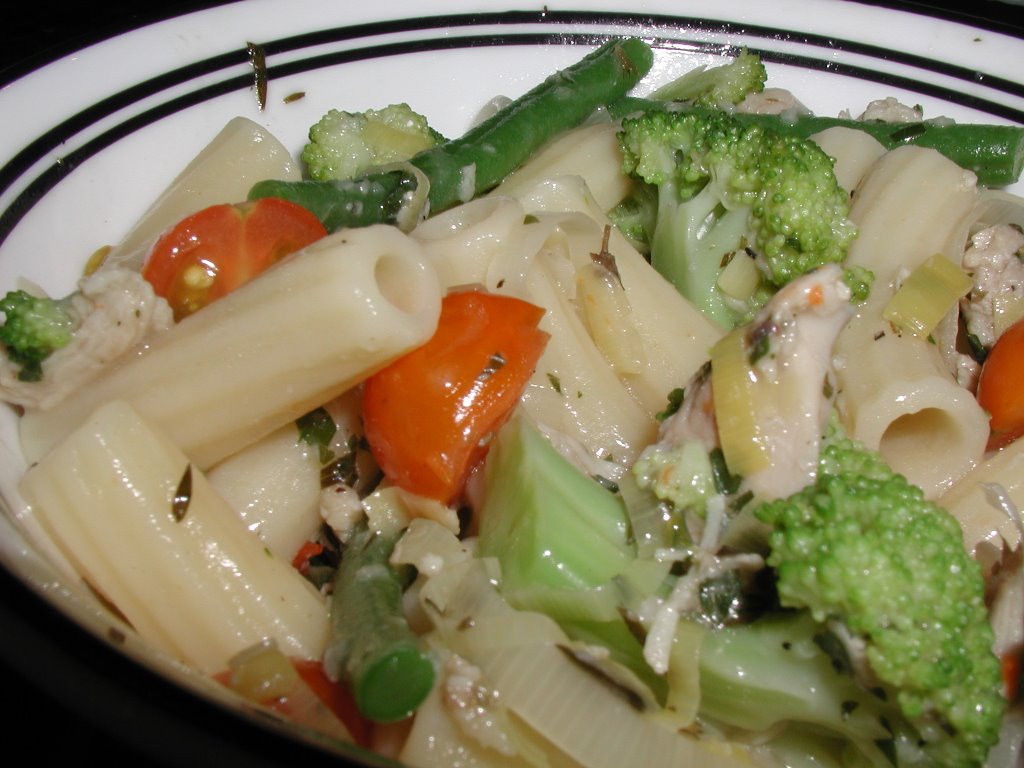
So remember that chicken I roasted earlier in the week? Tonight I turned it into a really tasty summer pasta dish that's also pretty good for you. The recipe is loosely based on one from Cook's Illustrated Janary 2005 issue, but only loosely. For one thing, I cut the fat in the recipe by about 3/4, and didn't miss it a bit.

Be sure to use a wine that you like in this pasta - a huge amount of the flavor of the pasta sauce will come from it, so this isn't the place to use up the dregs of something someone left at your house. I used a 2005 Seigneurs de Bergerac Bergerac Sec. It's one of my favorite wines for keeping around the house - it's a little bit fruity and just a tiny bit off-dry and goes with every food I've ever tried to serve it with. And at $7.99 from my local wine seller, it's got huge QPR (quality to price ratio). This French wine comes from a region adjacent to but not in Bordeaux, so it's got a lot of what makes white Bordeaux great, but at a non-Bordeaux price. (Although, to be fair, there's a lot of good white Bordeaux available for not much more.)

Light Summer Pasta
1 tbsp butter
1 leek, thinly sliced (white and light green parts only)
6 medium cloves garlic, minced
1/4 tsp red pepper flakes
2 tsp chopped fresh thyme leaves
2 tsp all-purpose flour
1 c dry white wine (but only a wine you like)
2 c low-sodium chicken stock (preferably homemade)
4 c broccoli florets
2 c trimmed green beans
1/2 lb penne or ziti pasta (I used Martelli, an excellent imported Italian pasta)
10 oz leftover cooked chicken, in pieces
1.5 oz parmesan reggiano, grated
1/2 c cherry or grape tomatoes, sliced in half (I used some tiny orange tomatoes from the Farmer's Market)
1 tbsp chopped fresh parsley
Salt and pepper

Bring 4 qts water to boil in stockpot.

Melt butter in a large skillet, and saute the leek with a pinch of salt until soft, about 2-3 minutes. Stir in garlic, red pepper flakes, thyme, and flour, and cook, stirring constantly for about 30 seconds. Add wine and chicken stock. Bring to a simmer, then reduce heat and simmer. The sauce will reduce and thicken slightly.

While the sauce is simmering, add 1 tbsp salt to the boiling water. Add the green beans and cook for 1 minute. Add the broccoli and cook for 2 minutes. Use a slotted spoon to transfer broccoli to a plate or bowl.

Bring water back up to a boil, stir in pasta and cook until al dente.

Just before the pasta is done, stir leftover chicken, parsley and parmesan cheese into the sauce and cook until pasta is heated through - about 1-2 minutes. Check the seasoning and add salt and pepper as necessary.

Combine the drained pasta, sauce, cooked vegetables and tomatoes. Toss and serve immediately. The sauce is fairly thin, so you might prefer to serve it in a bowl or just with some bread to sop up that tasty sauce.

Serves 6.

Monday, August 28, 2006

Sunday Chicken Dinner

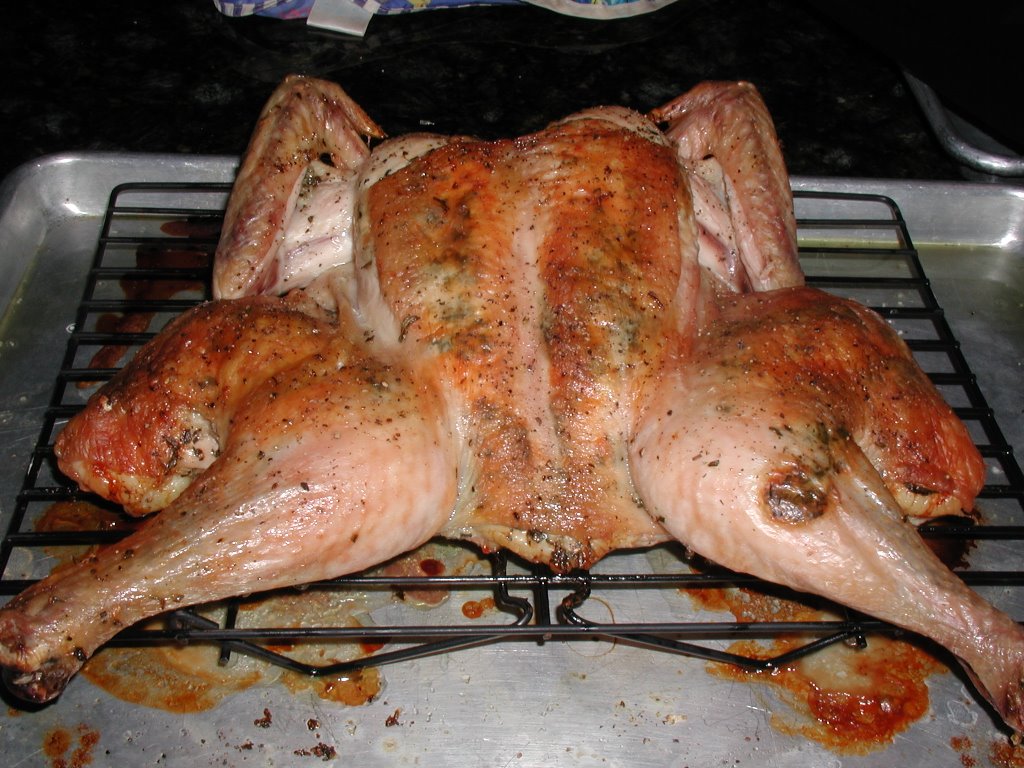
Okay, it was actually Monday chicken dinner, since I didn't get around to making it yesterday. But fortunately, as the picture demonstrates, I've recently discovered the wonder of butterflying (aka spatchcocking) a chicken, which actually makes roast chicken do-able for a weekday dinner. Spatchcocking has a bunch advantages - the meat cooks faster and more evenly, and it's a cinch to carve. It's ideal if you want to grill a whole chicken. But on day 3 of rain here in Ann Arbor, I was happy to use my oven.

Since this was a weeknight dinner, I prepped the chicken last night to save myself some time and effort today. Butterflying a chicken is easy - you just cut out the backbone with kitchen shears, turn it over, then push down firmly on the breastbone, cracking it and allowing the chicken to flatten out. (Follow the link above for an illustrated guide.) For seasoning, I made a paste of crushed garlic, finely minced rosemary, salt, pepper and a little olive oil and rubbed it under the skin on the breasts and legs - you can see a little bit of the green through the skin in the picture. Then I put salt and pepper on the outside, covered it and put in the fridge. So all I had to do when I got home was preheat the oven and get it in.

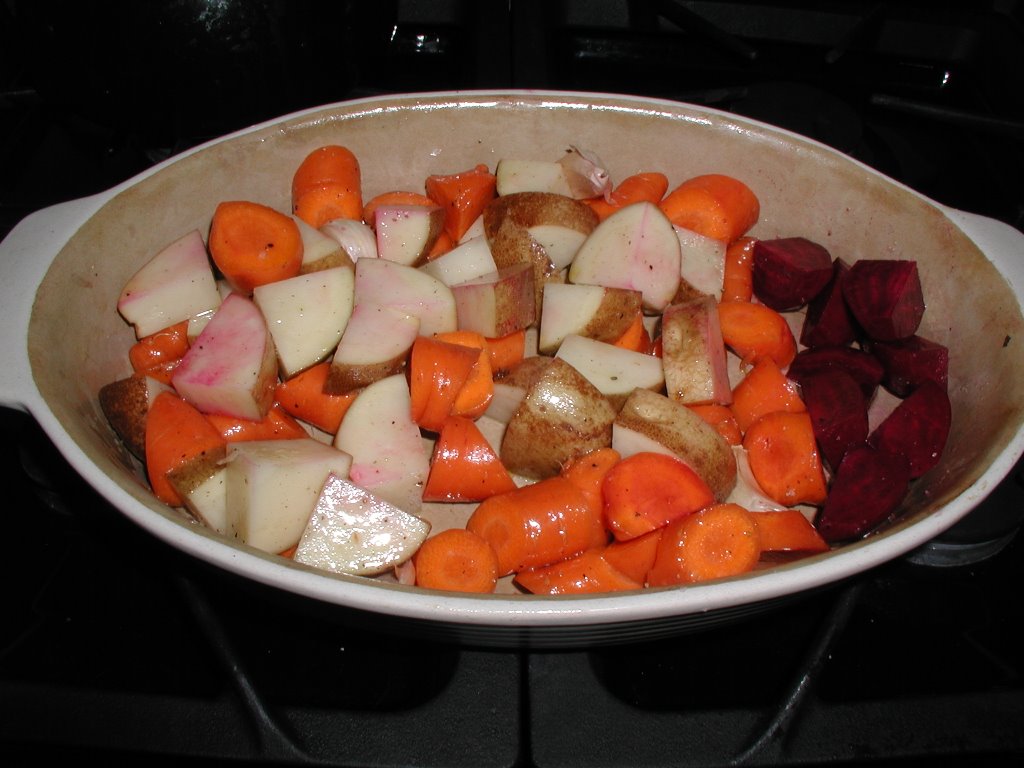
While the oven was preheating, I started prepping some veggies for roasting. I put the beets off to one side for color preservation purposes, and so as not to taint my beet-hating husband's portion of the veggies. I tossed everything with a little olive oil, salt, pepper, and handful of garlic cloves still in the paper, and put that in the oven with the chicken. Voila - now nothing to do except wait for it to be done.
Well, there was one more thing - slicing up some great local heirloom tomatoes for a little tomato salad. I had four different color tomatoes which would have been beautiful all together, but I knew that that would be too much for just two adults and one non-tomato-eating toddler, so I picked two.
I cooked everything at 400 degrees F. The chicken took less than an hour from start to finish. The veggies took about the same amount of time, but went in later, which made the timing perfect for them to just finished when the chicken had finished its 15 minute rest.

With a 4.5 lb chicken and only the three of us, I knew we'd have a bunch leftover. I carved off the breasts and served those tonight, then pulled the rest of the meat off the bones and put it away for soup or casserole making later this week.

The meat was juicy and flavorful, and infused with a mild garlic rosemary flavor/ aroma. The roasted vegetables were great - the slightly crispy potatoes, sweet carrots, and earthy beets made for a nice combination of flavors, textures and colors. And it's hard to go wrong with fresh picked tomatoes this time of year.

Sunday, August 13, 2006

Butter is exactly what steak needs

Dinner Saturday: grilled steak with chorizo butter with heirloom tomato, arugula and bread salad.

The chorizo butter is a tasty mixture of butter, dry-cured imported Spanish chorizo, roasted red peppers, parsley, garlic and smoked sweet paprika, combined in the food processor then formed into a log and chilled. We cut it into disks and used them to top the steaks we grilled. Butter on steak - now that's decadent! Tasty, and all pretty and orange-red and speckled. I still have half a log in the fridge to do something else with - I think it would be great on fish or chicken as well - maybe even more so, as they have greater need of a flavor boost than a good dry-aged steak does.

For the salad, I bought five different kinds of heirloom tomatoes at the market - red ones and yellow ones and "black" ones. They got chopped up with some scallions, and mixed with a dressing of dry vermouth, ground coriander, lemon zest, salt and olive oil. I brushed thick slices of day old Zingerman's rustic Italian bread with olive oil and grilled them, then rubbed them with a cut garlic clove and tore them into chunks. The bread and tomato mixture got tossed together with some arugula, torn basil leaves and toasted pine nuts, and c'est fini! I love bread salads - the bread soaks up all the yummy juices from the other ingredients, and it's lovely.

Looking on the wine rack for something to serve, I came across a bottle of 2000 Bordeaux (2000 Chateau Roland La Garde Prestige Premieres Cotes de Blaye FR) that I picked up in a mixed case some time ago. Nothing says Bordeaux like a hunk of dead cow, so that's what I served. Quite the enjoyable wine, and I must admit to a slight overindulgence and some tipsiness. I had been thinking to serve something Italian, concerned that with a salad as the side dish, I'd need a somewhat acid wine to match. But the salad is actually quite nice that way from a pairing perspective - since the dressing is made with vermouth rather than vinegar, the acidity in the salad comes only from the tomatoes themselves, making it quite wine friendly.

Dessert was a couple of storebought gelatos our dinner guests brought - a hazelnut chocolate and a dulce de leche. Both were very tasty.