Showing posts with label fruit. Show all posts

Thursday, December 14, 2006

Robert is Here

I first read about this farm stand in Issue 70 of The Art of Eating. When I found out I was going to be in Homestead, FL for work, I had this vague inkling of having heard of that area before. Eventually I discovered the Fruit and Spice Park, which had been featured in the same article as Robert is Here, and slowly but surely I started to remember why all of this seemed so familiar.

Once I put all the pieces together, it was an easy decision to scrap my plans to hit South Beach and check out art-deco hotels, and instead take myself on a culinary tour of this south Florida farming community.

Robert is Here is certainly a strange name for a farm stand. Here's the story, according to the Art of Eating article:

[Robert's] father was a farmer who used brokers to sell his produce. One day a broker said he'd been unable to find a buyer for a large supply of cucumbers. Robert's father asked for them back, so he'd at least be able to reuse the crates. But what to do with the cucumbers? He decided to put his six-year-old son to work.

He dropped the boy off at a nearby crossroads on a Saturday morning, along with a table, the cucumbers and some change in a coffee can. Robert sat all day. When he was picked up at dusk, he hadn't sold a single cucumber. No one had even stopped.

That can't be, thought the father. Perhaps people hadn't even noticed the small boy? He retrieved two hurricane shutters from the barn, spray-pained "Robert is Here" on each, and sent the boy back out on Saturday morning.
Okay, today this story would end up in child neglect charges, but this was 1961. Robert sold all the cucumbers, and a business was born. He started taking donations of extra produce from neighboring farmers, although when they found out how much money he was making, he had to start paying them. During the school year, he'd set up his stand with a can labeled "honor system" during the day, and get dropped off by the school bus to work the afternoon shift. By the time he was age 8, things were too busy during the day to leave the stand alone, so Robert hired his first employee.

Robert is Here continues to be a family affair. When Robert was helping me pick out fruit for my Taste of the Tropics party, he pointed out all of his kids to me, working at various tasks around the stand. It's a friendly, family kind of place, just like you'd expect. Robert himself was a great host, cutting a perfectly ripe passionfruit in half for us to share, and helping me select guavas and papayas that would be perfectly ripe in exactly 2 days time (and they were).

I didn't try one of his famous Key Lime milkshakes - something I sorely regretted when my dinner plans got pushed back a couple of hours. In addition to fruits and vegetables, both ordinary and exotic, the stand also features a huge variety of sauces, jams, jellies and honeys, most of which are available on their website. They also ship citrus, and perhaps other fruit as well.

Robert is Here
19200 SW 344th St (aka Palm Dr)
Homestead, FL
305-246-1592

Monday, December 11, 2006

Taste of the Tropics

I came back from Florida with a suitcase full of fruit. Not oranges and grapefruits, as might be expected this time of year. My selections were a little more unusual. Spiraling clockwise to the center from bottom left: kumquats, black sapote, papaya, guava, dragonfruit, passionfruit, atemoya and carambola. I'd tried some of these before, but others were completely new. I'd always rather share a new discovery than keep it to myself, so I invited a bunch of friends over for a Taste of the Tropics.

The black sapote was the most unusual fruit we tried, I think. It's ripe when the outside is green black and extremely soft. The inside contains several large seeds and a very soft, chocolate pudding colored pulp. In fact, the texture is a lot like chocolate pudding too - very creamy and custardy. Flavorwise, it's hard to describe. It's very mild and slightly sweet, but somehow also suprisingly addictive - we just keep going back to it until the skin was scooped clean!

This is the inside of the Atemoya. It contains several dark black and poisonous seeds, which I'd removed before taking this picture. It's a hybrid of two slightly better known tropical fruits, the sugar apple and the cherimoya. The rollinia pictured in my Fruit and Spice Park post is also in the same family. The flesh is cool and moist and smells a little bit like mango and pineapple. The flavors are in the same vein but mostly sweet with a mild tanginess. This one was many people's favorite.

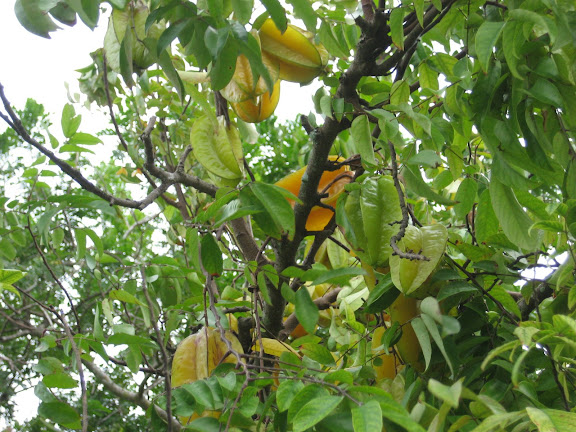
I forgot to take pictures of our next two fruits. After the Atemoya we moved on to Carambola. You've probably seen it before - when cut across the fruit, it looks like a star (thus it's more common name of star fruit) and is commonly used to decorate fruit trays. They come in several varieties. This one was among the sweetest, and even then it wasn't very. It was a deep yellow color and smelled like green peppers. It was very juicy and mild, slightly sweet and slightly tangy.

The contrast with our next entry was certainly pronounced! Kumquats are very intense. The pith is not as powerfully bitter as oranges and lemons and the like, but it does impart a bitter aftertaste. The pulp is sour, but there's some sweetness in there too. We found that it was much better to pop one in your mouth whole and eat it all at once than to take bites of a single kumquat. Eaten all together, the flavors meld into a very harmonious whole.

Dragonfruit is the fruit of a cactus. It's more pretty than tasty - you can understand its importance as a desert fruit because the flesh is just bursting with water. It smells kind of melony and floral. With the crunchy seeds, it's very reminiscent of kiwi fruit, but without the acid tang of kiwi. Instead there's sort of a mild watery flowery sweetness. Coming after the pungent kumquat, this made for a nice palate cleanser, but I'd probably change the order were I to do this again.

Most of us weren't very fond of the papaya. It looks and smells very much like cantaloupe. It tastes like... well... papaya. There's a hint of something odd about it. We think it's the latex - green papaya is a prolific source of latex, from which the meat-tenderizing enzyme papaian is produced - and that flavor seems to stick around even in the ripe fruit. It was much better sprinkled with a little lime juice. We also tasted the seeds, which have a distinct peppery bite. It was easy to see see why in some countries dried papaya seeds are used to adulterate more expensive black peppercorns.

We had to move the guava off the table while we were tasting the earlier fruits, because its lovely fruity muskiness was overwhelming our attempts to smell the milder fruits. But upon cutting, what was a pleasant aroma in the whole fruit became quite acrid and sharp. Once we could get past the smell, however, the flavor was really nice. Something like a cross between an apple and pear with a hint of musky mystery. This was definitely one to eat cut into wedges, so everyone could experience the variety of flavors and textures. It went from a a pear like skin to a really creamy smooth bit right in the center.

Passionfruit is one of my favorite flavors. When I made some passionfruit chocolate truffles for a sale earlier in the year, I was surprised to hear that many of my customers were not familiar with passionfruit. People were really skeptical that this was going to be good - a passionfruit is ripe and ready to eat when the outside starts to get wrinkly and dessicated. They're very light, so it's easy to think that it's going to be all dried up. But instead, they're filled with a tart and tangy pulp that surrounds a bunch of seeds (which you can eat or not as you so desire). Mmm.

I bought all these fruits at a Homestead, FL fruit stand called Robert is Here. More details on this mecca for fruit lovers is still to come.

Friday, December 08, 2006

Fruit and Spice Park


Carambola (aka Star Fruit)

This week, I had the opportunity to visit a really fascinating place - the Fruit and Spice Park in Homestead, FL. This 35 acre botanical garden has over 500 varieties of exotic fruits, herbs, spices and nuts from around the world. The park was mostly flattened by Hurricane Andrew, and they are still rebuilding. But there's plenty to see. Tours by tractor-driven tram are offered three times a day, and I highly recommended timing your visit to start with one. The biggest problem with the park is that the signage is nearly non-existent, so a tour is almost a necessity to know what you're looking at. And what you're tasting - visitors are invited to eat any fruit that's on the ground. Picking off of trees is forbidden to all except the tour guides, who will provide you with plenty of tasty snacks as they take you around the park.

The park is open year round, and because of Florida's climate and the diversity of plant species, there's always something new coming into season. Most of the fruits that are ripe that day are available for tasting at the gift shop/park entrance building. Fruit can't be taken out of the park, and none are available for sale. But fortunately, there's an excellent fruit stand just a few miles away called Robert is Here that carries many exotics. (Stay tuned for more about Robert is Here in a near future post.) Here are a few of my favorite pictures from the tour - check out my web album to see the rest and take a virtual tour with descriptions.


The stunningly beautiful flowers of the Guiana Chestnut.


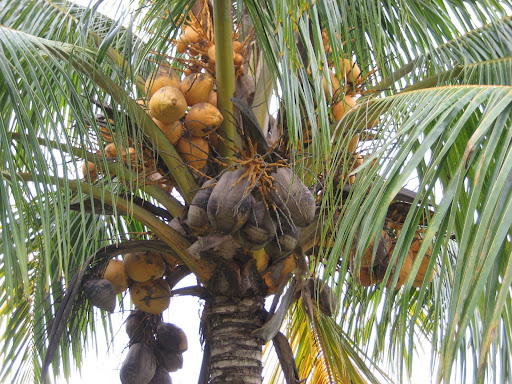
Yellow coconut palm


Balsam Pear - considered a weed, but the prettiest I've ever seen!


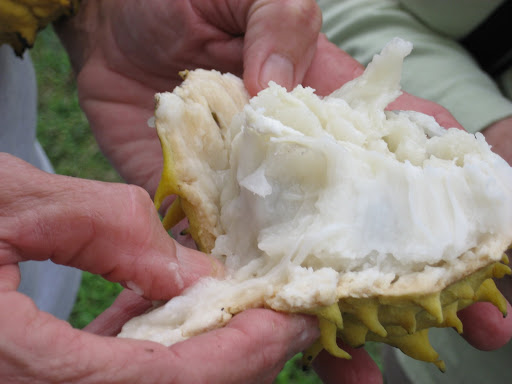
Eating Rollinia (aka "snot fruit") fresh from the tree. Yum!

If you're a foodie in Florida, I highly recommend making a stop here. It's just 35 miles south of Miami, and right on the way to the Florida Keys.

Fruit & Spice Park
24801 S.W. 187th Avenue
Homestead, Florida 33031
305-247-5727

Tuesday, November 07, 2006

The importance of tasting

I named this blog Tammy's Tastings for a couple of reasons. One, I like alliteration. And two, and perhaps more importantly, because I think that consciously tasting is the best way to learn about food.

I've run and attended tastings of a huge variety of foods - olive oil, vinegar, bacon, maple syrup, to name but a few. When my husband bought me a four pack of single origin chocolate bars for Valentines Day, the first thing I did was invite friends over for a side by side compare and contrast.

Blind tasting in particular is important. Every month I learn something new from the blind tastings we use in my wine club. Whenever we eat or drink something, we bring to it a lifetime's worth of experience and emotion and knowledge. I "know" that I like French wines better than domestic. So hand me a glass of California Chardonnay and a glass of White Burgundy, and I'm going to look for things I like in the Burgundy, and things I don't like in the California Chard. It's human nature. Hiding all the identifying features of a wine, or a food, or whatever it is, really lets you taste it on its own terms.

I was inspired to write this post by a recent experience with apples. I grew up eating Macintosh apples. That's what my family bought, and I barely knew that other kinds of apples existed! (Okay, I knew about Red Delicious, but even then I recognized that they were a triumph of appearance over flavor.) When I grew older and more worldly, I started eating other kinds of apples. Jonagolds, Empire, Pink Lady, Granny Smith. I found a couple that I particularly liked - Golden Delicious and Honeycrisp - but for the most part I wasn't an apple fan. But I never bought Macintosh. Those were the "average" apples. The "regular" apples. I was a gourmet. I was too sophisticated for the simple Mac.

A couple weeks ago, someone put some apples out for dessert. The package just said "apples." I took one, and it was the best apple I'd tasted in years. And - as I'm sure you've guessed - it turned out to be a Mac.

Tasting is important.

Sunday, September 03, 2006

A tale of two berries

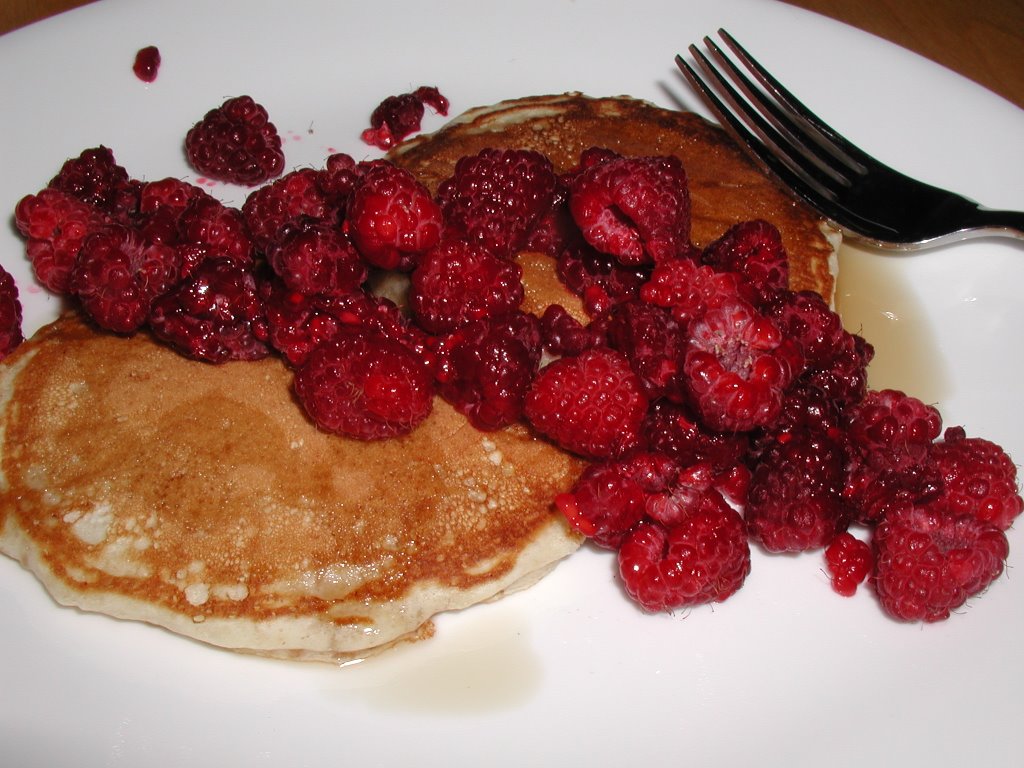
Our Michigan blueberries are fading into a distant and expensive memory. There were still a few at the Farmer's Market on Saturday, but they are up to $5 a pint - a few weeks ago they were $6 a quart. Fortunately, the raspberries are in full swing, and they made a delightful topping for homemade pancakes this morning.

It's a pretty generous topping, and that's because fresh, local, raspberries are ephemeral. Yes, they are soft, juicy, tart and yielding. But the very ripeness that gives them their deep red color and divine flavor means that they turn from marvelous to moldy in a minute. So they invite excess. The race is on - can we eat an entire quart of raspberries before they go bad? (So far the answer has been yes.)

Supermarket raspberries might as well be another species entirely. Here's a picture I took today of a package I bought about a week and a half ago, in a momentary lull in my supply of the fresh local kind.

10 day old raspberries, and not a spot of mold on them. Excellent for shipping, not so good for eating. They're as firm as they look, with large noticeable seeds. Dry, not juicy. More pink than red. And, well, the flavor just isn't much to speak of.

Come winter I'll probably be happy to have something - anything - even a pale imitation of late summer's flavor. But for now, I'm happy that I've got three farmer's markets a week at which to stock up on the real thing.

Monday, August 14, 2006

Red Haven Peaches

I've never really paid much attention to peach varieties. Apples, I knew. Macintosh, sweet and tart and good for sauce and pies (if you like your pies mushy). Granny Smiths, tart and green, good for pies that you didn't want mushy. Red Delicious - the opposite of its name, and to be avoided at all costs.

But peaches were those hard fuzzy balls I bought in the grocery store for my husband. Or so I thought until last summer, when I discovered Red Haven peaches at my local Farmer's Market last year. Red Haven peaches are everything you want a peach to be. Firm on the outside, sweet and pungent and dripping-down-your-chin juicy on the inside. Luscious peaches.

I tried some other peaches from my Farmer's Market earlier this year, expecting them to be just as good, by virtue of being fresh and local and picked when they were ripe. But that's when I learned that varieties matter for peaches just as much as they do for apples. And I've been holding out for the Red Havens ever since.

While excellent for eating out of hand, Red Haven peaches are also good grilled, especially with a little balsalmic vinegar brushed on them first. It's a tasty way to use up the heat that's left in the coals when you've finished grilling the rest of your dinner. Serve with vanilla ice cream for an especially decadent treat.