Showing posts with label chocolate. Show all posts

Tuesday, March 06, 2007

Chocolate Tasting

On Sunday I invited a bunch of friends around to taste some chocolate with me. I'd ordered some E. Guittard single origin bars to taste, and then had collected up various odds and ends
I'd gotten in trade from people on the net. I wanted to taste them all alongside the basic couvertures I'm using for my chocolate making, to see if there was something I should be using instead, or if any of them called out for use in a particular pairing.

We tasted 13 different chocolates - 10 dark and 3 milk.

Dark Chocolates
1. E. Guittard 61% (B)
2. Noel 64% (B)
3. New World 64% (U)
4. E. Guittard Sur del Lago Venezula 65% (SO)
5. E. Guittard Quevedo Ecuador 65% (SO)
6. E. Guittard Chucari Columbia 65% (SO)
7. E. Guittard Ambana Madagascar 65% (SO)
8. Valrhona 2002 Chuao Venezuala 65% (SE)
9. E. Guittard 72% (B)
10. El Rey Apatmate Carnero Venezula 74% (SO)

Milk Chocolates
11. Callebaut Milk (B)
12. El Rey Irapa Rio Caribe 40% (SO)
13. E. Guittard Orinoco 41% (B)

B=blended, SO=single origin, SE=single estate, U=unknown

I have a horrible chocolate vocabulary, so I don't have detailed tasting notes to share. But I was pleased that the E. Guittard chocolates I have been using stood up well against the rest. I didn't particularly like the El Reys - as one attendee, also a chocolatier, said "I know I'm supposed to be impressed by El Rey, but I'm just not." The 74% in particular was downright unpleasant - kinda chalky. I'm not really sure what #3 was - it was labeled as "New World 64%" but I can't find anything like that anywhere on the net.

Of the four Guittard single origin bars, the Ecuadoran (#5) was the favorite. Mostly, I think, because it tasted the most like how we expect chocolate to taste. The others were more varietally distinct. #6 was interesting - woody, smokey and kind of peaty - might be good on it's own as a single origin truffle.

#8, the single estate bar, was very complex. Lots of layers of flavor. It comes from the Chuao cocao bean, which is only grown in one small place in Venezula, which is only accessible by the ocean, blah-blah-blah... Very unique, very interesting. It's a vintage chocolate, in that it has a year of harvest associated with it, and is made only from beans from that harvest. This was a freebie that I got from Chocosphere when I placed my giant chocolate order with them recently.

#2 came from an eGullet friend who traded me her go-to chocolate pistole for some of my bonbons. It was quite different from the others in the tasting, I think because it has much lower acidity than the others. It had some distinct anise and cinnamon kind of notes. Some people thought it was almost peanut-buttery. It's not a clean enough tasting chocolate that I would want to use it for general use, but I may play around with it for for a cinnamon or peanut butter center, places where it's unusual character will contribute.

The milk chocolates were, well, milk chocolate, which I mostly don't like. But the E. Guittard Orinoco was better than the other two, so I'll keep it as my basic milk chocolate for now. Even my friend Sue liked it, and she generally doesn't like milk chocolates that are high in cocoa content. So if I've found a milk chocolate that both she and I like, then it's definitely a keeper!

Wednesday, February 14, 2007

Happy Valentine's Day!

Please enjoy this virtual box of chocolates, from the the Valentine's Day collection that I offered through my fledgling business.
Top row: salty caramel, passionfruit, hazelnut praline. And in the center with the hearts, strawberry-balsamic.

The salty caramel is based off of this recipe from Epicurious. I used 2 tsp of coarse gray sea salt and only cooked it to 240 degrees. I used a very high bf content cream and butter, which made for a really nice texture and flavor to the caramel.

For the passionfruit, it's 4 ounces of chocolate, 3 ounces of cream, and just under an ounce of passionfruit concentrate.

The hazelnut praline recipe is from the new Andrew Garrison Shotts book. Caramelize some sugar, pour it over some toasted hazelnuts, and then let that cool. Break it into pieces and puree them in a food processor until it becomes a paste. The praline paste is then mixed with a little bit of milk chocolate and some cocoa butter for the filling. Very assertive and interesting flavor.

The strawberry balsamic was inspired by the Shotts book as well, although I made a lot of changes. There's a layer of strawberry pate de fruit on the top, and then a layer of dark chocolate balsamic vinegar ganache below. On the left, you can see what it looks like on the inside. The method is rather complicated, so I'm not going to post it here, but feel free to comment or email me if you want the recipe.

Here's hoping your Valentine's Day is sweet!

Monday, February 05, 2007

Truffles, Candy and Confectionary

I picked up this book on a recent Amazon splurge. After I took a look through, I almost sent it back. The truffle recipes are all very basic. And essentially variations on a theme, as the method is nearly identical for each page, it's only the ingredients that vary. Good for a total beginner to truffles, but I'm well past that stage now.

I decided to keep it, however, for the candies and confections portions. While I've developed an intuitive sense of how to work with ganaches for truffles, caramel is still something of a mystery to me, and this book had a bunch of interesting caramel recipes to try. Not to mention nut brittles, marzipans, fruit jellies, and fudges.

The recipes are straightforward and easy to follow. This weekend we had a big party to go to on Saturday night, so I used that as an excuse to try out not one, not two, but THREE different recipes from the book. All of which turned out really well.

At the bottom are Espresso Caramels, in both wrapped and chocolate covered versions. To the left, wrapped and chocolate dipped versions of the Honey Nut Caramels. To the right and in the middle (with the chopped nuts on top) is a slightly overcooked Hazelnut Butter Crunch. It's definitely edible, but darker than I would have preferred. The caramels are both good, but the honey nut is the best.

Here's what the caramels look like inside:

My verdict: If you're new to candy or truffle making, this is an good book. It covers all of the basics, in an approachable style and with methods that don't require a lot of specialized equipment. If you've already got some confectionary experience, then you'll probably find it too simplistic and would be better served with a different book. Even a beginner might have that experience - do you really need a recipe to tell you to temper some chocolate and mix it with roasted peanuts? Or, a couple pages later, the same recipe but with coconut instead? But there are some gems in the mix, and a good grounding in basic techniques, so it's certainly worth a look.

Friday, December 29, 2006

Chocolate Scandal!

From Scott at DallasFood.org comes this tale of Noka, a high-end chocolatier headquarted in Plano, TX and named "#1 luxury chocolate in the world" by some British food show. I'm familiar with many chocolatiers (Richart and Kee's being among my favorites), but this was one I hadn't heard of before the article.

It's a long article, but well worth the read. It peels away the layers of deception the proprietors of Noka have set up around themselves. Reading their press, or even hearing them in interviews, you'd think that they are chocolate makers - taking carefully sourced cacao beans and turning them into their own couverture. But in fact, they're doing just what the rest of us are doing - buying a pre-made couverture and turning it into truffles and bon-bons.

But the rest of us aren't getting paid their prices! A 2-piece "encore" box of truffles is $17.50 - a princely $8.75 per truffle! A 4-piece box from the Vintages collection (tastings squares of single origin chocolates) is $16.00. Think that's extravagant, but not outrageous? Each tasting square weighs only seventy-five one thousandths of an ounce, meaning the price for the chocolate is $853/lb. And all Noka has done is temper the couverture they've bought and formed it into squares. I just tempered chocolate twice in the last 2 hours, and I can tell you it's not worthy of that kind of money! The truffles work out to $666/lb. Even names like La Maison du Chocolat and Michael Recchiuti - among the the most well known and expensive chocolatiers - top out at a mere $85/lb for their chocolates, which have carefully conceived fillings and actually required some thought!

Through some careful detective work, Scott actually manages to figure out what couverture the people at Noka are using, and reveals just how outrageous that markup really is. I won't spoil the surprise for you, because the story is very entertainingly told. It was like watching a soap opera - I kept gasping, shaking my head and saying "I can't believe it!"

Sunday, December 24, 2006

Merry Christmas!


Since I can't actually give you truffles for Christmas, I can at least give you some recipes. These are from my holiday truffle sale, featuring four seasonal flavors. I ended up making over 400 hand-rolled, hand-dipped truffles. Kinda crazy!

I expect you don't want to make quite that many, but fortunately the recipes scale down easily. For all these recipes, you should let the ganache set up at room temperature for about 12 hours, then scoop them into balls. If you are dipping in tempered chocolate, it's especially important to let the balls set for 24 hours to dry out a bit and develop a crust. This will help limit cracking and leaking. But if you just want to coat with melted chocolate and cocoa powder, you don't have to wait that long.

Chestnut Truffles (about 90)
12 oz dark chocolate
24 oz chestnut spread (sweetened chestnut puree, basically)
6 oz unsalted butter
1 tbsp brandy

These turned out to be my favorite. Rich and decadent. Easy to make because I went with a commercial chestnut spread. To make, melt the chocolate and let it cool to near room temperature. Mix with softened butter, then stir in chestnut puree and brandy.

Cranberry Truffles (about 90)
18 oz dark chocolate
12 oz cream
2 tbsp unsweetened cranberry concentrate

This concentrate is really potent stuff. You can find it in health food stores. It's liquid, in a bottle - mine was in the juice aisle. Use any standard ganache method: pour hot cream over finely chopped chocolate and let stand for a couple minutes before stirring to emulsify, or melt the chocolate and combine it with the warm cream. Add the cranberry concentrate after the ganache is fully emulsified.

Egg Nog Truffles (about 70)
24 oz white chocolate
4 oz egg nog
1 vanilla bean
3/8 tsp nutmeg
2 oz rum

Steep the vanilla bean and nutmeg in the egg nog. Reheat and strain, and combine with white chocolate using your favorite ganache method. Add the rum. If you're dipping in tempered chocolate, garnish with some white choco

Gingerbread Truffles (about 80)
21 oz milk chocolate
7 oz cream
1/4 tsp black pepper
1/4 tsp allspice
1/4 tsp cloves
1/2 tsp ginger powder
2 tsp cinnamon
4 tsp molasses
1.5 tbsp ginger juice

Black pepper was the magic ingredient to make these actually taste like what I was looking for. And the combination of powdered ginger and juice from fresh works really well. Bring the cream to a boil and combine with spices. Let steep for about 10 minutes. Reheat, then remove from heat and stir in molasses. Combine with chocolate in whatever ganache method you prefer. Add ginger juice when fully emulsified. (To make ginger juice, finely grate fresh ginger, then squeeze it through cheesecloth or a towel.)

Tuesday, November 28, 2006

Booty from Canada


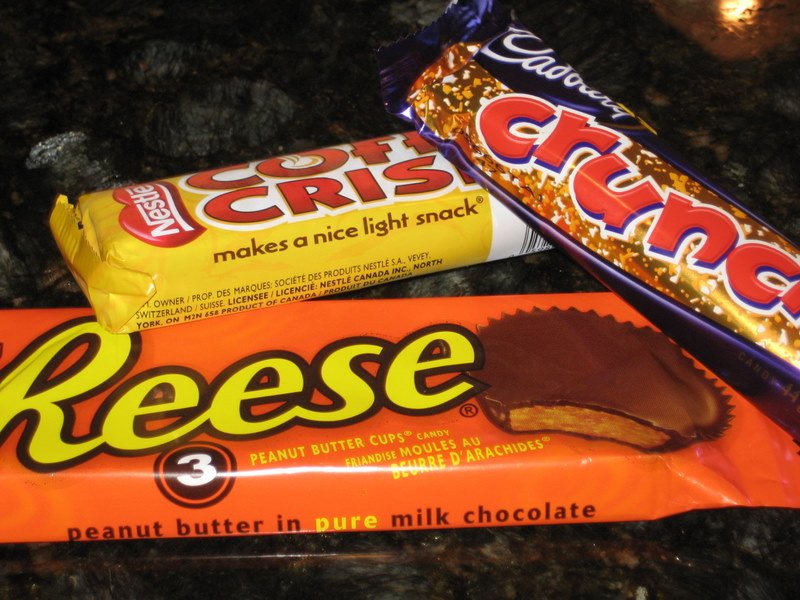
So, in a previous post I wrote an ode to the Canadian McChicken Sandwich, but that's not the only thing I miss from the old country. The chocolate bars (note: not "candy bars") are also generally superior to their American counterparts. The milk chocolate is similar to British milk chocolate, and doesn't have that waxy chalky Hershey's flavor. That's why the Reese peanut butter cups are pictured above - sure, you can get those here, but the Canadian ones taste completely different because of the superior chocolate. And I think the peanut butter filling is a little less sweet. Note that they are "Reese" not "Reese's" and that they come in a pack of 3 as their standard size.

Above the peanut butter cups is Coffee Crisp. My husband tells me that they have these in the vending machine at his office building, so perhaps they are available in the US now. (Just checked, and according to coffeecrisp.org, Nestle began marketing them nationally in the US in July of 2006.) But for a long time they were the number one chocolate bar people requested for me to bring back from Canada. According to its Wikipedia page, Coffee Crisp is "a combination of coffee cream, cookie wafers and milk chocolate coating." I like them alright, but my husband is the real fan in the family. He especially likes eating them frozen.

I've saved my favorite for last. Crunchies. A Crunchie is sponge toffee covered in milk chocolate. The sponge toffee has a nice bitter edge that makes for a perfect counterpoint to the chocolate. The only downside is a tendency to stick to your teeth. But they are definitely one of my all time favorite chocolate bars. I understand that sponge toffee isn't very hard to make, so I may try my hand at making a homemade version.

(Not pictured: the Crispy Crunch I ate before I thought about this blog post. As described in the link, it's a lot like a Butterfinger - the same flaky crunchy kind of texture - but the flavor is different and much better. Butterfingers always taste really artificially flavored and nasty to me.)

Wednesday, November 08, 2006

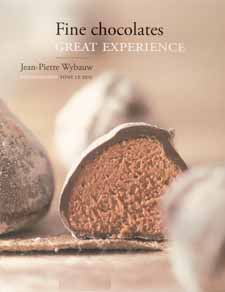
Wish List: Fine Chocolates, Great Experience

The more I learn about chocolate making, the more I realize how little I know. I started this truffle making thing on a whim, and now I'm pretty much hooked. At this point I'm making hand dipped truffles, mostly with ganache centers. I added a caramel to the mix this last batch, spreading my wings a little bit. But there's a whole world of chocolate to explore out there, and from what I've heard, this book is the tour guide to take with me.

In addition to over 100 recipes, Jean-Pierre Wybauw's book features detailed scientific information on things like crystallization and shelf life, which will be particularly important as I start to think about broader distribution of my creations. Candymaking is a very precise art, and getting a deeper understanding of the whys and and wherefores will help me to figure out why something did or didn't work.

But at the price (even heavily discounted at Amazon it's $59.85) it's not something I can just pick up on a whim. So onto the wish list it goes.

Sunday, October 29, 2006

Halloween Candy for Grownups

Starting last Mother's Day, I've been doing occasional chocolate truffle sales for my friends, coworkers, and neighbors. While Mother's Day and Father's Day are more typical occasions for such a thing, I decided to explore some creative flavors and market Halloween Candy for Grownups. I had orders for about 220 candies, and have been working on and off since Wednesday. Truffle making mixes periods of intense activity with long blocks of time spent waiting for things to set up. Last night was the final big push.


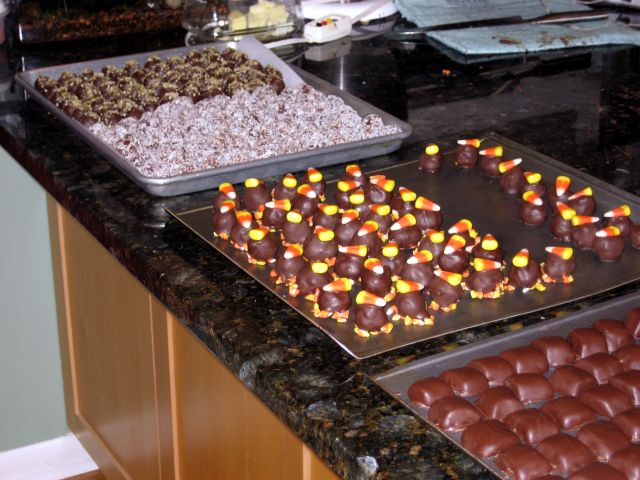
Here they are, all laid out and ready for packaging:
The flavor assortment:
L to R: Pumpkin Seed Praline, Coconut Ghosts, Candy Corn, Caramel Apple

For the pumpkin seed praline, I caramelized sugar and mixed in toasted pumpkin seeds, then cooled it and chopped it up fine. The ganache was 8 oz butter, 11 oz chocolate, and 6 oz of praline. These were dipped and sprinkled with extra praline. Using butter instead of cream in the ganache allows the praline chunks to stay crunchy. (Melt the chocolate, then let it get quite cool and stir in room temperature butter and then the praline.)

The coconut ghosts are 12 oz chocolate, 8 oz coconut milk, and 1 tsp coconut extract, coated in chocolate and rolled in unsweetened coconut.

The candy corn are just a plain chocolate ganache (12 oz chocolate, 8 oz cream), dipped in tempered chocolate and garnished on the top and bottom with candy corn.

For the caramel apple, I made an apple cider infused caramel, cut it into pieces, and dipped it in chocolate.
Apple Cider Caramels
2 c apple cider
Reduce to 1/3 cup, set aside.

2/3 c cream
6 tbsp butter
Heat to boil, then set aside.

1 1/2 c sugar
1/4 c corn syrup
1/4 water
Cook to light brown

Add cream, butter and reduced apple cider all at once, stirring constantly (it will foam up - use a good size pot). Cook to 250 degrees, using fairly low heat - you want to take about 10-15 minutes to get it up to temperature. Pour it into a 8 inch square baking pan that's been lined with two pieces of oiled parchment paper, one in each direction - this creates a "sling" to pull the caramel out of the pan. (If you're new to caramel making, this is a just a variation on this recipe, and the link includes more detailed instructions.)
I like the flavor, but I'm still trying to figure out how prevent the caramels from spreading so much after they're dipped - they were supposed to be nice cubes, not flat squares...

All boxed up for gift giving:
I've got the usual small amount of overrun to get rid of, as last minute sales and/or for dessert tonight for my birthday cassoulet party.

Friday, September 29, 2006

In Search of Vegan Truffles

A few times a year I make chocolate truffles to sell to friends and neighbors and coworkers. It's my little cottage industry that helps me pay for things like Zingerman's special dinners, or my upcoming trip to Chicago. I know a couple of people who are vegan or otherwise sensitive to dairy, and they asked if I'd thought about making vegan truffles. Not one to turn down a challenge, I started looking in to it.

For dark chocolate truffles like I make, the main non-vegan ingredient is the cream. Cream brings both a liquid component and fat to the truffle equation. There are lots of other liquids you could use for truffles, but most of them don't have enough fat. Even soy cream subsitutes are lower in fat than the real thing. But coconut milk is a high fat liquid that at least one vegan truffle maker uses, so I decided to give that a try.

But then I found out that not all sugar is vegan! So that added another wrinkle to the project, since most chocolate contains sugar, and ingredient lists don't often specify whether it is bone-char processed... So I needed to figure out what chocolates were safe. Fortunately, this was easy enough, using the power of the Internet.

I went off to my local natural foods store and picked up a bar of Green&Black 72% baking chocolate to experiment with. On its own, I'm sad to say the stuff tasted pretty nasty, with a lot of heavy green notes. A little bit of greenness can be nice in a chocolate, but this was over the top. It was slightly better when made into truffles, but I wasn't happy with the results.

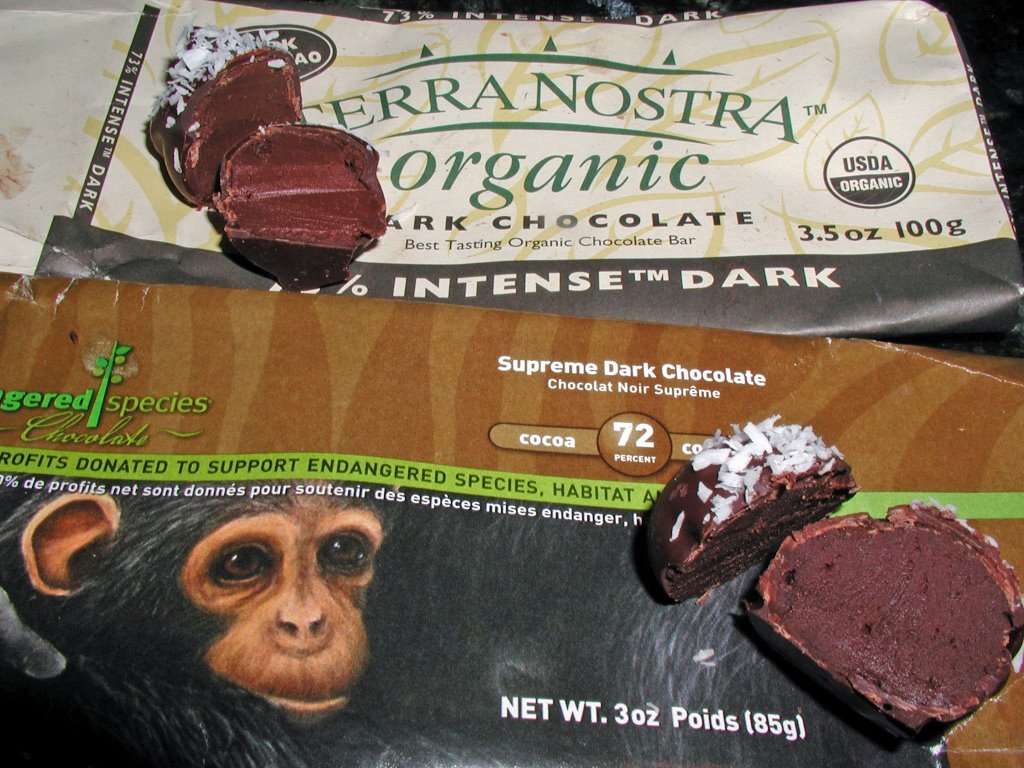
So this week I grabbed a couple different bars and did a taste test.

Fortunately, both of these chocolates were better tasted plain than the first one I tried, so I was already off to a better start. Alone, I had a slight preference for the Endangered Species Supreme Dark Chocolate - it was a little rounder, a little sweeter, and had an interesting sort of nutty-coffee thing going on in the background. The Terra Nostra Organic 72% Intense Dark seemed darker and edgier and sharper, but with just a hint of what I hadn't liked in the first one. My fellow tasters were mixed in their preferences, so it was clear we needed to take it to the next step - an actual comparison of ganaches.

The most surprising thing in the ganache making was the color. The Terra Nostra, which tasted so much darker, was actually surprisingly light colored as a ganache. Odd. It was also far, far superior in taste. The nutty-coffee thing in the Endangered Species overpowered the coconut milk and coconut extract in the ganache, whereas the Terra Nostra ganache was nicely integrated. Ding-ding-ding! We have a winner.

Saturday, August 19, 2006

Peanut Butter and Bacon Truffles

Really.

I'm finding the recipe strangely enticing.

And while we're talking about strange things to do with bacon, anybody up for a bacon martini?